There’s a moment many owners of older Riverhead homes experience: running a hand along a brick foundation wall or chimney and feeling mortar crumble away like damp sand. It’s easy to dismiss , the house has stood for eighty years, surely it can stand a few more. Usually it can. But the crumbling joint is rarely the whole story. It’s the visible edge of three slow-moving processes , brick movement, mortar deterioration, and water infiltration , that feed each other until a cosmetic issue becomes a structural one.
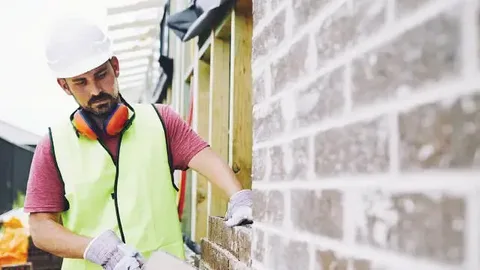
TrueLine Home Improvement Inc works on aging masonry across the East End, from farmhouse foundations near the Peconic to early-1900s chimneys in the village, and the pattern repeats: older masonry doesn’t fail the way modern masonry does, and it can’t be repaired the way modern masonry is. This article explains why , and what a qualified masonry contractor actually does differently on a pre-war structure.
Old Masonry Is a Different Material System
A brick wall built in 1930 and one built in 2010 look similar and behave nothing alike.
The mortar is softer , on purpose. Older Long Island masonry was typically laid with lime-rich mortar. Lime mortar is flexible, slightly self-healing, and breathable: it lets moisture inside the wall evaporate out through the joints. Modern Portland cement mortar is far harder and nearly waterproof.
The brick is softer too. Many older bricks were fired less uniformly than today’s. Their outer face , the fire skin , is the hardest part; the interior is comparatively porous.
The wall breathes as a system. Soft brick plus soft mortar works because moisture moves through the joints, sacrificing mortar slowly instead of brick. Joints are meant to be renewed every several decades. That’s not failure , that’s the design.
The single most damaging “repair” an old wall can receive is hard Portland mortar smeared into soft-brick joints. The new mortar becomes the strongest element, moisture is forced to exit through the brick faces instead, and within a few freeze-thaw winters the brick faces pop off , a failure called spalling. The wall was repaired into ruin. This is why pointing and repointing on older structures is a specialty trade, not a bag-of-mix job.
The Three Forces Working on Your Walls
1. Brick movement
Masonry moves more than people assume. On the East End, the drivers are:
- Seasonal ground moisture swings , Riverhead’s mix of loamy and sandy soils expands and settles with the water table, especially near farmland drainage and low-lying lots.
- Thermal cycling , a south-facing wall can swing 60°F in a day between winter sun and night frost.
- Foundation settlement , decades of gradual, uneven settling opens stair-step cracks along mortar joints.
Small, stable, hairline stair-step cracking is common and often manageable. Cracks that widen year over year, displace bricks out of plane, or run through the bricks themselves signal active movement that needs structural evaluation before any cosmetic work.
2. Mortar failure
Lime mortar erodes gradually , first losing its tooled surface, then receding into the joint, then loosening its grip on the brick. Accelerants include pressure washing (a surprisingly common cause of ruined joints), deicing salt splash along foundations and stoops, and constant wetting from failed gutters. Once joints recede past roughly a quarter inch, water begins collecting on the exposed brick ledges instead of shedding, and deterioration compounds quickly.
3. Water entry
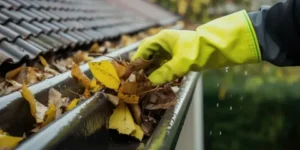
Water is the engine behind both other problems. Its entry points on older homes are predictable: open mortar joints, cracked chimney crowns, missing caps, failed flashing, unsealed brick below grade, and , most often overlooked , roof runoff pouring beside foundations because gutters and downspouts have failed. Once inside, winter turns every absorbed drop into a wedge. Freeze-thaw cycling is the East End’s most efficient demolition crew, working roughly a hundred cycles per winter.
The telltale that water is actively moving through your masonry is efflorescence , the white, powdery mineral bloom on brick or block. It’s not the problem itself; it’s the receipt water leaves behind.
Where Older Riverhead Homes Show It First
Local repair calls cluster in predictable places:
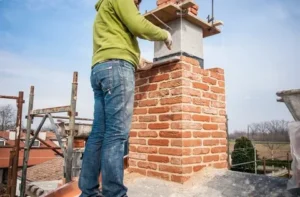
- Chimneys take weather from all four sides and fail earliest , open joints near the top, cracked crowns, spalled faces on the windward side. Because chimneys combine old brick, roofline flashing, and constant wetting, they’re often the first candidates for brick masonry repair in Riverhead, NY on any pre-war house.
- Foundation walls and stoops, where deicing salt and ground moisture attack from below while gutter overflow attacks from above.
- Brick and stone porches and steps, whose horizontal surfaces hold water by design and spall dramatically after hard winters.
- Original stone foundations on the oldest farmhouses, where lime joints between fieldstones wash out and let fine soil migrate through , a job for stone masonry restoration in Rocky Point, NY and across the North Shore’s stone-built housing stock.
What Specialized Repair Looks Like in Practice
A qualified restoration approach on an older structure follows a discipline that generic patching skips:
Diagnose the water first
Repointing a wall that’s still being soaked by a broken downspout is renting the repair, not owning it. The moisture source , roofline, gutters, grading, flashing , gets corrected first or concurrently.
Match the mortar, not just the color
Proper work on pre-war masonry starts with assessing the existing mortar’s hardness and composition, then blending a compatible lime-based mix. Compatibility means the new mortar remains slightly softer than the brick , preserving the sacrificial relationship the wall was built with. Color and joint profile matching come after compatibility, not instead of it.
Remove joints without wounding brick
Deteriorated mortar is raked or carefully ground to proper depth , roughly twice the joint width , without nicking brick edges. Sloppy grinder work permanently scars a historic façade; on soft brick, hand tools still earn their keep.
Rebuild, don’t just refill
Displaced bricks are reset, spalled units are replaced with salvaged brick of matching porosity, and structural cracks get addressed with reinforcement , helical ties or stitching where movement history warrants it , rather than cosmetic fill.
Manage moisture going forward
Breathable water repellents (never film-forming sealers, which trap moisture in soft brick), functioning caps and crowns, and corrected drainage close the loop. On chimneys, this is where repair work hands off naturally to masonry chimney repair detailing , crown, cap, and flashing as one system.
The Cost Logic of Acting Early
Masonry deterioration is unusual among home repairs in how nonlinear its pricing is:
- Open joints caught early: repointing affected areas , a moderate, per-square-foot expense.
- Joints plus early spalling: repointing plus selective brick replacement , costs multiply as brick sourcing and matching enter the job.
- Structural displacement: partial rebuilds, reinforcement, possibly engineering , an order of magnitude beyond simple pointing.
- Interior water damage on top: framing, insulation, and finishes join the invoice.
The same wall generates all four invoices, depending only on when it’s addressed. Nothing else in this trade rewards early intervention as reliably.
Practical Guidance From the Scaffold
- Walk your masonry every spring with a screwdriver. If you can carve a joint with light hand pressure, it’s due.
- Never let anyone pressure-wash old brick at close range or high pressure , it excavates joints and opens brick pores.
- Treat efflorescence as a diagnostic, not a stain to be scrubbed. Find the water.
- Keep gutters and downspouts working; more foundation masonry is destroyed by roof runoff than by age.
- Ask any bidder two questions: What mortar mix will you use, and why is it right for this brick? A contractor who answers “standard Type S” for a 1920s wall has just told you everything you need to know.
Frequently Asked Questions
How do I know if my mortar is lime-based or Portland cement?
A field clue: lime mortar scratches easily with a nail or screwdriver and tends to crumble to a sandy powder; Portland-rich mortar is glassy-hard and resists scratching. Age helps too , most Long Island masonry laid before roughly the 1930s–40s is lime-rich. A repair specialist can confirm with a simple assessment before specifying a mix.
Are stair-step cracks in my brick wall an emergency?
Not automatically. Narrow, stable stair-step cracks following mortar joints often reflect old, completed settlement. The concerning versions are cracks that measurably widen over months, cracks wider than about a quarter inch, displacement where one section sits proud of another, or cracking through brick faces. Photograph and date suspicious cracks , comparison over a year tells you whether movement is live.
Why did my brick faces start popping off two winters after a repointing job?
That history strongly suggests the wall was repointed with mortar harder than the brick. Hard joints redirect moisture through the softer brick faces, and freeze-thaw cycles shear them off. The remedy, unfortunately, is removing the incompatible mortar and repointing correctly , which is why mortar compatibility is worth insisting on the first time.
Can spalled bricks be repaired, or must they be replaced?
Lightly spalled units in low-visibility areas can sometimes remain, protected by corrected drainage and breathable treatment. Bricks that have lost their fire skin, however, will continue absorbing water and deteriorating. The durable fix is replacement with salvaged or reproduction brick matched for porosity as well as appearance.
Is sealing old bricks a good idea?
Film-forming sealers are actively harmful on older masonry , they trap moisture inside soft brick and accelerate spalling. Vapor-permeable (breathable) siloxane-type repellents, applied to sound, repointed masonry with water sources corrected, can be beneficial. Sequence matters: sealing is the last step of a repair, never a substitute for one.
How long should quality repointing last on an older Long Island home?
With compatible mortar, correct joint preparation, and managed water, several decades , 30 to 50 years is a reasonable expectation for lime-based repointing done well. That lifespan is exactly why cutting corners on a job you’ll only commission once or twice in your ownership rarely makes financial sense.
Closing Thoughts
Old masonry fails slowly and forgives early attention generously. The walls of an older Riverhead home have already survived a century of nor’easters; what they can’t survive is water left running and repairs done with the wrong materials. If your joints are receding, your brick is blooming white, or a previous patch job is visibly failing, have the wall evaluated by someone fluent in old masonry before winter adds another hundred freeze-thaw cycles to the bill. The screwdriver test costs nothing , and it’s the cheapest structural inspection you’ll ever perform.